The Margin Mirage: When Growth Masks the Slow Erosion of Value
- mt4656
- Dec 22, 2025
- 4 min read
There is a moment many founders recognise — often too late.
The company is busy.
Revenue is rising.
The team is stretched.
Customers are coming in.
And yet, something feels wrong.
Despite the activity, the reward feels thinner.
Despite the effort, the outcome feels muted.
Despite growth, value isn’t accumulating as expected.
This is not failure.
It is something more subtle — and far more dangerous.
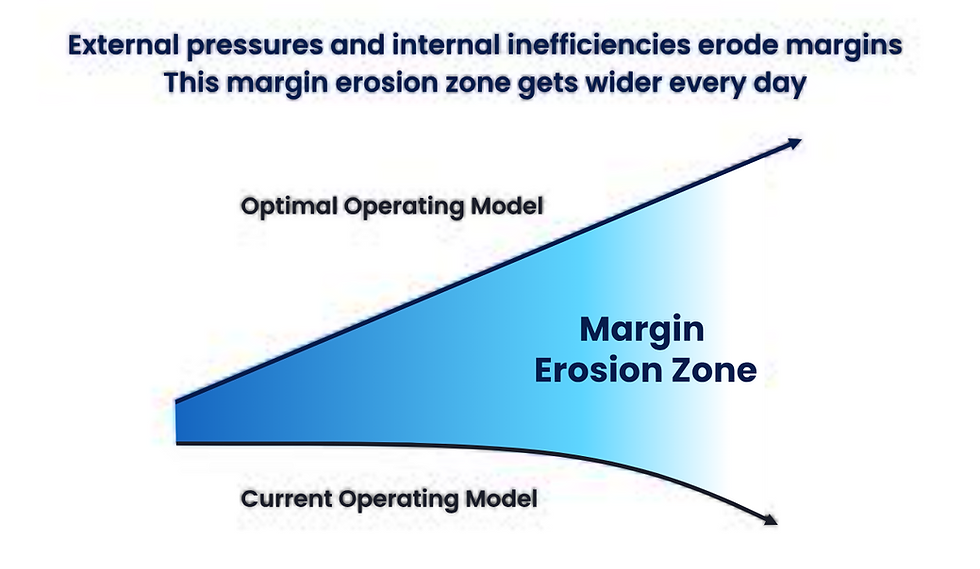
It is the margin mirage: the illusion that growth automatically protects profitability, while margins quietly erode beneath the surface.
Growth Can Hide More Than It Reveals
One of the most persistent myths in business is that margin problems announce themselves clearly.
They don’t.
Margins rarely collapse overnight.
They decay gradually.
A discount here to close a deal.
A hire there to support delivery.
A cost increase absorbed “for now”.
A pricing review postponed.
A customer exception that becomes a precedent.
Each decision makes sense in isolation.
Together, they slowly change the economics of the business.
By the time leadership notices, the problem is no longer tactical.
It is structural.
Why Margin Decay Is So Easy to Miss
Margin decay hides because it lives inside averages.
At board level, we often see:
blended gross margin
consolidated contribution
headline profitability
These figures can look stable even as value leaks away underneath.
What they conceal is variation:
by customer
by product
by contract
by geography
by channel
High-valuation companies obsess over where margin is created — not just whether it exists.
The High Valuation Triangle: Where Margin Really Comes From
Margin quality is not an operational detail.
It sits at the heart of the High Valuation Triangle.
1. Intellectual Property Monetisation
IP does not automatically create margin.
Poorly monetised IP can be one of the fastest ways to destroy it.
This happens when:
pricing does not reflect value
delivery effort is underestimated
customisation is absorbed for free
licensing terms shift risk back to the company
High-valuation businesses treat IP as an asset with:
clear pricing logic
disciplined scope
repeatable economics
They protect margin not by selling more — but by selling better.
2. Succession and Management Depth
Margin decay accelerates when decisions concentrate at the top.
Founders often approve:
discounts
exceptions
special terms
Because it feels quicker.
But without financial frameworks embedded into management, margin discipline becomes personality-driven instead of systemic.
Companies with management depth:
price consistently
enforce boundaries
understand contribution
escalate exceptions deliberately
This is how margin protection scales beyond the founder.
3. Scaling and Expansion (Including Going Global)
Expansion amplifies margin risk.
New markets bring:
unfamiliar cost structures
pricing pressure
regulatory friction
delivery complexity
If margin assumptions are copied rather than rebuilt, expansion becomes a value drain.
High-valuation companies redesign margin models before they scale — not after.
The Emotional Cost of Margin Erosion
Margin decay doesn’t just affect numbers.
If affects leadership.
Founders begin to feel:
they are working harder for less
growth is less rewarding
decisions carry more weight
there is less room for error
This pressure often manifests as:
hesitation
micromanagement
over-involvement
fatigue
What looks like a leadership issue is often an economic one.
When margins are strong, leadership feels lighter.
When margins weaken, everything feels heavy.
Why Investors React Before Founders Do
Experienced investors are highly sensitive to margin quality.
They listen for:
pricing logic
cost awareness
contribution understanding
repeatability
discipline under pressure
When margins are vague, investors assume:
“Growth is compensating for weak economics.”
And they price the business accordingly.
Valuation is not driven by revenue alone.
It is driven by confidence in margin durability.
The Quiet Difference Financial Leadership Makes
Strong financial leadership does not chase margins aggressively.
It designs for them.
This includes:
segment-level margin visibility
pricing architecture
contribution analysis
delivery cost control
disciplined exception handling
Margin becomes intentional — not accidental.
This is where companies transition from being busy to being valuable.
The Risk of Waiting Too Long
Margin decay compounds.
What starts as a 2–3% erosion becomes:
lower cash generation
tighter funding
weaker negotiating power
reduced strategic flexibility
Eventually, leadership is forced to:
cut costs abruptly
reset pricing under pressure
justify decisions to investors
At that point, optionality is already reduced.
A Closing Reflection
Revenue growth is visible.
Margin quality is not.
One attracts attention.
The other determines endurance.
The companies that achieve high valuations are rarely the loudest or the fastest-growing.
They are the ones that:
monetise IP deliberately
embed financial discipline into leadership
protect margins as a strategic asset
scale with economic intent
Margin decay is not a mistake.
It is a signal.
And the earlier it is understood, the more quietly — and effectively — it can be corrected.
About the Author
Matteo Turi is a Chartered Accountant (ACCA), Board Director, and CFO with nearly three decades of experience across blue-chip corporations, startups, and scale-ups.
He is the author of Fail. Pivot. Scale: The High Valuation Code Revealed and creator of The Exponential Blueprint, a framework for valuation growth through IP monetisation, leadership succession, and international expansion. Read more at www.matteoturi.com or connect on LinkedIn


Comments